







Multiple Payment Options ✔️ Fast and discreet shipping ✔️ Customer Service Monday - Friday 10:00 - 16:00 ✔️ Free Goodies
Fast and discreet shipping!

THE POWER OF ROUTINE EXPLAINED
The world is often unpredictable and your life is generally very busy. This can make it difficult to create and maintain routines, which is a shame as they can have a positive effect on your mental health, productivity and general well-being. In this article, we therefore mention the power of routine and why habits can be so important for our functioning.
What is a routine?
You should think of a routine as a series of actions that you perform regularly. Often, you do this on autopilot without really thinking. For example, you might have a morning ritual or a set time when you eat lunch. You might also have a standard time when you put your phone away to go to sleep. These habits create a certain predictability in our lives. As a result, we tend to spend less energy and time making choices and planning tasks.
How do routines help your brain?
Our brains are constantly processing huge amounts of information. By automating certain behaviours, it saves energy. Scientists call this mechanism "habit formation". According to this research by Carol A. Seger and Brian J. Spiering, this involves the basal ganglia. This part of the brain helps us perform tasks more and more efficiently without having to think about them consciously. This creates space in the prefrontal cortex, the part of the brain responsible for complex thinking and decisions. It also allows you to use your cognitive capacity more effectively to face new challenges because you don't have to keep wasting your energy on basic tasks.
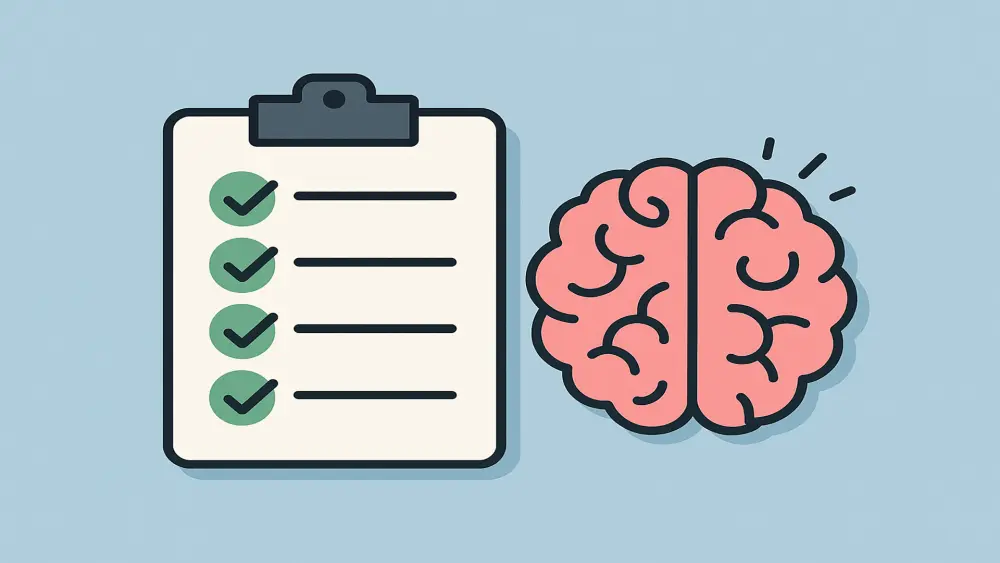
The power of routine to reduce stress
A stable routine can also reduce stress. Uncertainty and chaos in your day create unnecessary mental pressure. Studies show that predictability in daily actions has a calming effect on our nervous system. This is because routines provide a sense of control and security, which lowers the hormone cortisol. This is the stress hormone, which is why it is important to lower its production. It is therefore important to learn healthy habits, according to this research by Kirsti A. Dyer. This may even reduce your risk of dying prematurely, according to her study.
The influence of routines on productivity
Routine can also contribute to productivity. A well-known method for this is the "habit stacking" technique, where you link new habits to existing routines. This makes learning new behaviours smoother and more natural. This 2016 study therefore shows that some habits can have a positive impact on your productivity. In particular, habits related to your attitude can make you more productive.
How do new habits emerge?
According to expert Charles Duhigg, habits are created through the "habit loop", which he wrote about in The Power of Habit. They are created through a cycle of signal, routine and reward. The signal then triggers a certain behaviour (the routine) and the brain links this routine to a reward, reinforcing the habit over time. According to experts, developing new habits takes, on average, as much as 66 days. However, the timeline can vary depending on the complexity of the habit and individual needs.

How do you build an effective routine?
If you want to create an effective routine yourself, it is wise to make use of these tips and advice:
- Start small: Small steps that are achievable make it easier to stick to routines. For example, if you want to start meditating, you would do well to start with five minutes a day instead of an hour.
- Be consistent: Learning a new habit can take over two months, so it is important to be consistent. The power of a routine therefore lies in repetition. Therefore, try to perform your new habit at the same time every day.
- Use triggers: Link a new habit to an existing action. For example: after brushing your teeth, meditate for 2 minutes.
- Make it fun: If something is fun and enjoyable, you will stick to it faster. Therefore, it is a good idea to combine your new routine with something you enjoy doing. For example, listen to your favourite podcast while running.
Source
1. Habit formation / Habit formation
- Wood, W., & Rünger, D. (2016)Psychology of Habit. Annual Review of Psychology, 67, 289-314.
Describes the scientific mechanism behind habit formation and the role of automata in the brain. Link (open access version via author): https://www.ncbi.nlm.nih.gov/pmc/articles/PMC4853878/
2. The role of the basal ganglia in habit learning
- Seger, C. A., & Spiering, B. J. (2011)A critical review of habit learning and the basal ganglia. Frontiers in Systems Neuroscience.
Link: https://www.frontiersin.org/articles/10.3389/fnsys.2011.00066/full
3. Habit loop and practical explanations.
-
Charles Duhigg:The Power of Habit ( book).
Website with explanation: https://charlesduhigg.com/the-power-of-habit/
Disclaimer: The information in this article is based on scientific studies and intended for general information. It does not replace medical advice or treatment. If symptoms persist, always consult a specialist.