







Multiple Payment Options ✔️ Fast and discreet shipping ✔️ Customer Service Monday - Friday 10:00 - 16:00 ✔️ Free Goodies
Fast and discreet shipping!

Kratom names explained: what do Bali, Thai, Borneo and Dragon mean?
If you look at the various kratom products available, you’ll come across all sorts of kratom names. As well as Red, Green and White, you’ll see, for example, Bali, Thai, Borneo and Dragon. Some of these names have a geographical origin, whilst others are mainly used as brand names. But what do these names actually tell you about the product? In this article, we explain where well-known kratom names come from, what they mean and what to look out for when comparing products.
Bali, Thai and Borneo have a geographical origin but are also used as product names. Dragon is primarily a brand name.
Table of contents:
Where do kratom names such as Bali, Thai and Borneo come from?
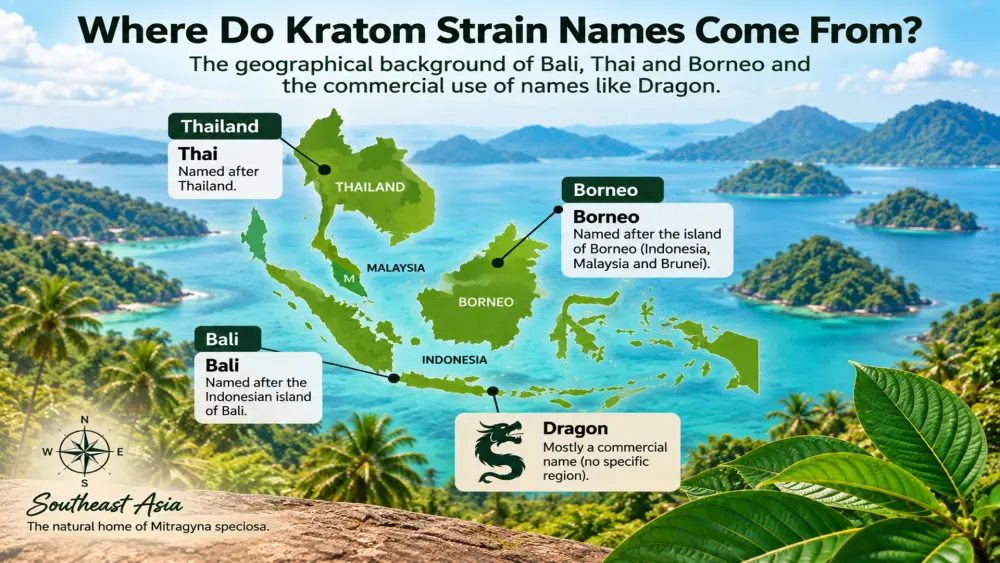
Kratom is made from the leaves of Mitragyna speciosa, a tree native to South-East Asia.[1] Over the years, various names have emerged within the kratom market to distinguish different products from one another. Some have a geographical origin. ‘Thai’, for example, refers to Thailand, and ‘Borneo’ to the island of Borneo. Other names, such as ‘Dragon’, are mainly used as trade names.
There is no international system that precisely defines when a product may be called Bali, Borneo or Dragon. You should therefore regard such a name primarily as just one part of the product information. The origin, the plant material used and the processing method can provide additional information about what you are actually buying.
What do Bali, Thai, Borneo and Dragon mean in relation to kratom?
Although these names regularly appear alongside one another in a kratom range, they do not all have the same background. Bali, Thai and Borneo are geographically-sounding designations, whilst Dragon is mainly used as a commercial product name.
What is Bali Kratom?
The name ‘Bali Kratom’ refers to the Indonesian island of Bali. However, within the international kratom market, ‘Bali’ is also used as a product or trade name. You cannot, therefore, regard the name as a definitive indication of origin without further information.
Bali can also be combined with a colour category, resulting in names such as Red Bali, Green Bali and White Bali. Later in this article, we explain how such combinations are formed.
What is Thai Kratom?
Thai Kratom refers to Thailand, a country with strong links to the history of kratom. Mitragyna speciosa occurs naturally in parts of South-East Asia, and kratom has a history of traditional use in the region.[1][2]
However, the term ‘Thai’ is not a protected designation of origin. The name on the packaging is therefore not automatic proof that the product in question was grown or processed in Thailand. If you want to know the actual origin, check whether the supplier provides separate information on this.
What is Borneo kratom?
Borneo is not a country, but a large island in South-East Asia. The island comprises territory belonging to Indonesia, Malaysia and Brunei. The Indonesian part is known as Kalimantan and covers the largest part of the island.
The name ‘Borneo’ is widely used within the kratom market as a product designation. Therefore, the term ‘Borneo’ alone does not tell you which country or which part of the island the plant material used comes from.
What is Dragon Kratom?
‘Dragon’ differs from the three names mentioned above. There is no geographical kratom region called ‘Dragon’. The term is mainly used as a commercial product or trade name. For example, you may come across ‘Green Dragon’ and ‘Red Dragon’.
‘Dragon’ is not a separate botanical species of Mitragyna speciosa, and there are no universally applicable standards that a product bearing this name must meet. What ‘Dragon’ actually means can therefore vary from one manufacturer to another.
If you see ‘Dragon’ on a packet, the product description will usually provide more useful information about the specific product than the name ‘Dragon’ on its own.
Does a kratom name say anything about its origin?
Not necessarily. Names such as ‘Bali’, ‘Thai’ and ‘Borneo’ have a geographical background, but are also used as product names within the current kratom market. A name that sounds geographical is therefore not automatically the same as a verified indication of origin.
Do you want to know where a product actually comes from? Then look for specific details about the country, region or producer. This provides more clarity than the product name alone.
Also, bear in mind that there is natural variation. Kratom is plant material, and factors such as growing conditions, harvest time and processing can influence its composition. Scientific research into Mitragyna speciosa shows that the plant contains various alkaloids and that its chemical composition is the subject of ongoing research.[3] Two products from the same region or with the same trade name are therefore not necessarily identical.
How do Bali, Thai and Borneo differ from Red, Green and White?
This is where the naming can become confusing. Bali, Thai and Borneo, and designations such as Red, Green and White, do not in fact describe the same thing.
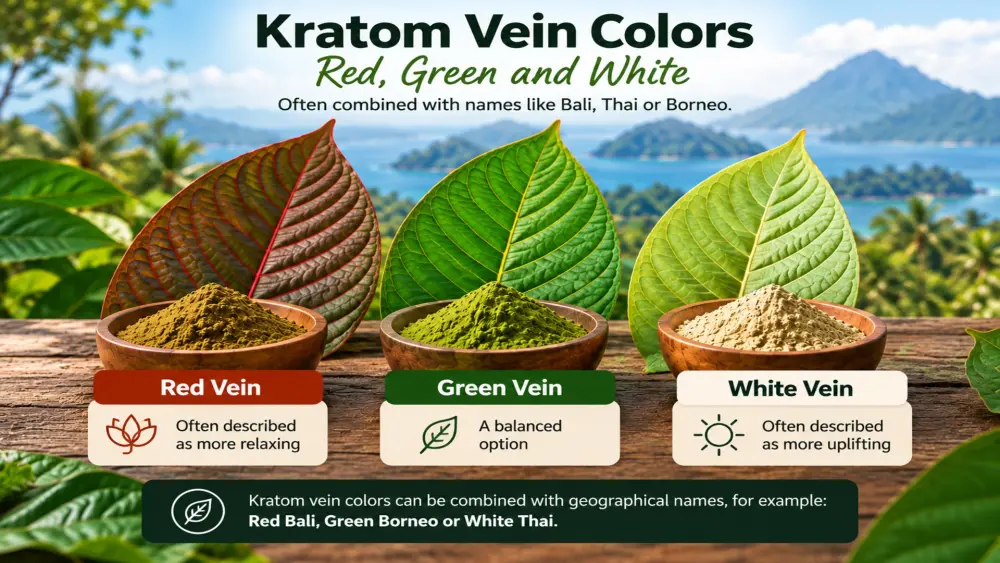
‘Red’, ‘Green’ and ‘White’ are used within the kratom market as colour categories. ‘Bali’, ‘Thai’ and ‘Borneo’, on the other hand, have a geographical background. Names such as ‘Maeng Da’ and ‘Dragon’ function primarily as trade or variety designations. You may therefore come across combinations such as:
- Red Bali: ‘Red’ is the colour category and ‘Bali’ is the geographical or commercial designation.
- Green Borneo: ‘Green’ is the colour category and ‘Borneo’ refers to the geographical origin of the name.
- White Thai: ‘White’ is the colour category and ‘Thai’ refers to Thailand.
In this way, a single product name can combine several classification methods.
Would you like to know more about the colour categories? Then read our article on the differences between Red, Green and White Vein.
Within the 24High range, we see that a single kratom name can consist of several parts. Product names such as Red Bali, Green Borneo and White Thai, for example, combine a colour category with a geographical or commercial designation. So don’t just look at a single word such as ‘Bali’ or ‘Borneo’, but at the full product name and the accompanying product information.
What should you look out for when comparing kratom names?
Once you understand how the different names are structured, it becomes easier to navigate a kratom range. Nevertheless, it is wise to look beyond just the eye-catching name on the packaging.
1. Check the actual origin
Are you specifically looking for kratom from a particular country or region? If so, check whether the supplier provides specific information on its origin. Do not automatically assume that a name such as ‘Bali’, ‘Thai’ or ‘Borneo’ indicates the exact place of production.
2. Review the full product information
As well as the name, compare the product form, ingredients and available information about the composition. This becomes particularly important when comparing different types of products side by side. With an extract, for example, the stated concentration or extraction ratio may provide more information than the trade name. So compare products based on their actual characteristics, not just on ‘Bali’, ‘Borneo’ or ‘Dragon’.
3. Understand how the product name is structured
A long product name doesn’t have to be complicated if you know what the different parts stand for. Take ‘Green Borneo’, for example: ‘Green’ refers to the colour category and ‘Borneo’ to a geographical or commercial designation. By looking at product names in this way, you can better distinguish which information a name actually provides and where you need to consult the product description.
Frequently asked questions about kratom names
Sources and scientific information
- National Centre for Complementary and Integrative Health (NCCIH) – Kratom.
- National Institute on Drug Abuse (NIDA) – Kratom.
- PubMed – Scientific research on Mitragyna speciosa and mitragynine.
- Botanical source on the distribution of Mitragyna speciosa in South-East Asia.
Disclaimer
The information in this article is intended solely for general and informative purposes and does not constitute medical advice or a substitute for professional advice, diagnosis or treatment. If you have any questions about your health, are taking medication, or are unsure whether kratom is suitable for your situation, please contact a doctor or other qualified healthcare professional. Please also bear in mind that regulations regarding kratom may vary from country to country and are subject to change over time.
More information about kratom
Would you like to find out more about kratom? Then take a look at: