







Multiple Payment Options ✔️ Fast and discreet shipping ✔️ Customer Service Monday - Friday 10:00 - 16:00 ✔️ Free Goodies
Fast and discreet shipping!

COLD SHOCK METHOD FOR MAGIC MUSHROOM GROW KITS: HOW TO APPLY IT SAFELY
If you want to grow mushrooms yourself, it’s good to know that this is not necessarily very easy. You definitely need knowledge of biological principles for this process, while patience and precision are also important. In addition, you must know which techniques are useful to apply. One of the techniques growers use to stimulate fruiting is the cold shock method, also known as cold shock. In this article, you’ll read more about it!
What is the cold shock method?
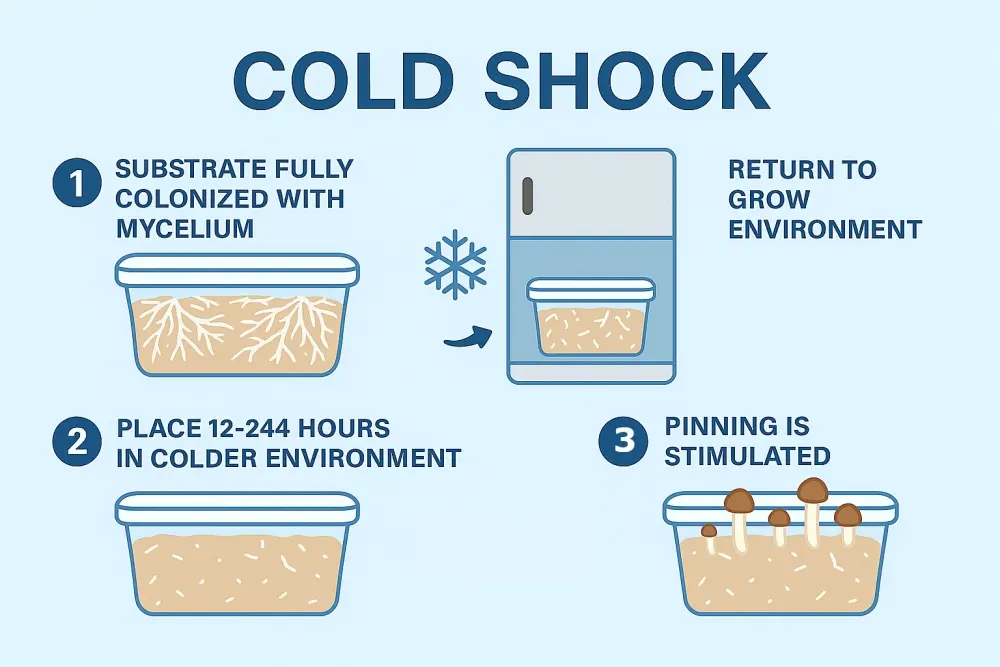
The cold shock method is a technique often used in mycology to stimulate the fruiting of mushrooms. In this method, the fully colonized substrate is temporarily exposed to a significant drop in temperature, usually by placing it in a cool environment. This is described by Paul Stamets in his guide ‘Growing Gourmet and Medicinal Mushrooms’. This method is believed to work well because the idea is that mycelium can recognize natural seasonal changes.
In nature, many mushrooms grow during periods when the substrate experiences warmer and more humid conditions after a cold spell. By introducing a controlled temperature drop, the mycelium is stimulated to develop primordia, or small pinheads, which later grow into mature mushrooms.
How does cold shock work?
In the cold shock method, mushrooms are stimulated to fruit. The mechanism behind this is both biological and chemical. When temperatures fluctuate, mycelium produces certain signals and hormone-like substances that promote the differentiation of cells into fruiting bodies, as described in Fungal Biology by J. W. Deacon. This process resembles stress responses in plants. A sudden change in environmental temperature triggers multiple biochemical reactions, thereby promoting reproduction and dispersal.
How can you apply cold shock with mushroom grow kits?
The application of the cold shock method requires precision to achieve the desired effect without damaging the mycelium. Therefore, it is important to perform the cold shock correctly, otherwise you might only damage the mushrooms. First of all, it is important that the substrate is fully colonized. Incomplete or weakly colonized substrate responds less well to temperature shocks and is more susceptible to contamination, as Stamets writes in his previously mentioned guide.
Next, the substrate must be exposed to a low temperature, usually between 2 and 10 degrees Celsius. It is important that this period does not last too long; usually a period of 12 to 24 hours is sufficient. If the exposure lasts too long, this can result in damage to the mycelium or delayed growth. Sometimes a longer period is used, especially with oyster mushrooms or shiitakes. However, this is not necessary for tropical mushroom species, nor for Psilocybe cubensis.
What to do after the cold shock
After the cold shock, the substrate must be returned to optimal fruiting conditions. The most suitable temperature depends on the species. This is usually between 22 and 25 degrees. Humidity must also be increased, preferably between 85 and 95 percent. In addition, sufficient fresh air and a light cycle that mimics natural daylight are crucial according to J. W. Deacon. By providing these conditions immediately after the shock, the mycelium is stimulated to quickly form pinheads and grow into healthy mushrooms.
It is important to carefully observe the substrate after the cold shock. The first signs of pin formation should be visible within a few days. No pins appearing? This may indicate substrate problems, unsuitable shock parameters, or contamination. It is therefore crucial to closely monitor the process and make adjustments where necessary. This way, you maximize your chances of a successful harvest of your mushroom grow kits with the help of the cold shock method!
Practical tips for the cold shock method
- Use a reliable cooling source: The cool room or refrigerator must be able to maintain a constant temperature.
- Monitor the time: The shock period should not last too long and should also be adjusted to the species. So keep a close eye on the time.
- Protect the substrate: It’s a good idea to place the substrate in an airtight container.
- Restore the fruiting environment: Light, air, humidity, and temperature must be optimal to stimulate pin formation; restore them immediately after the cold shock.
- Check the condition of the mycelium: The mycelium is only suitable for cold shock if it is completely white and healthy.
Disclaimer: This article is intended solely for informational and educational purposes and does not grant permission to cultivate illegal mushrooms. The cultivation of psilocybin-containing mushrooms is prohibited in many countries and may have legal consequences. 24High accepts no liability for illegal activities, damage, or health risks. Always consult local legislation and follow safety guidelines in all forms of mushroom cultivation. Use this information only for legal, scientifically sound, or educational purposes.