






Multiple Payment Options ✔️ Fast and discreet shipping ✔️ Customer Service Monday - Friday 10:00 - 16:00 ✔️ Free Goodies
Fast and discreet shipping!

THE BEST MEDITATIONS AGAINST STRESS: FIND MORE PEACE AND RELAXATION
Hans Selye (source 1.) once said about stress: “It’s not stress that kills us, it is our reaction to it.” In other words, how we respond to stressful situations matters a lot, according to him. Still, many people struggle with this, which makes sense. After all, stress is an inevitable part of life.
In this article, you'll learn what causes stress and what you can do about it. The meditations we mention here can actually help reduce stress!
What causes stress?
Everyone experiences stress, but our stress triggers can differ greatly. Some people suffer from work pressure, while others worry about their finances. Others may experience stress due to health or relationship problems. In other words, many situations can cause someone to feel stressed.
Scientifically speaking, stress is caused by cortisol and adrenaline, the two main stress hormones. However, according to this study (source 2.), other biological mediators also play a role.
How does meditation reduce stress?
Stress can be very unpleasant and may even lead to depression. H.M. Van Praag researched this (source 3.) and found that disruptions in stress hormones have a pathological significance in depression—they're not just a result of it. In other words, stress can lead to depressive feelings.
Meditations for stress
It’s only logical that you want to prevent this, so it's wise to take action against stress. According to this study by Doug Oman et al. (source 4.), meditation can help. The study examined the effect of meditation-based stress management practices among students.

The best meditations for stress relief
If you want to reduce stress, these meditations can help:
1. Body Scan
In a body scan meditation, you focus your attention gradually on different parts of your body, usually starting at the toes and moving upward to the head. This helps shift attention away from stress by tuning in to physical sensations.
2. Mindfulness
During mindfulness meditation, you typically focus on your breath. At the same time, you acknowledge and accept any thoughts that arise, which helps you observe your feelings and potentially reduce stress.
3. Mantra
In a mantra meditation, you repeat a calming word or phrase silently to yourself to reduce distractions. Think of the mantra as a lullaby for your mind, helping you relax and feel more at ease.
4. Music
Music meditations involve focusing on the sounds and rhythms of music. This can distract you from stress-inducing thoughts. It can be especially helpful for those who suffer from tinnitus.
5. Walking
You don’t have to sit still to meditate. If you prefer movement, walking meditation is a great option. It combines physical activity with awareness, helping to move stress into the background.
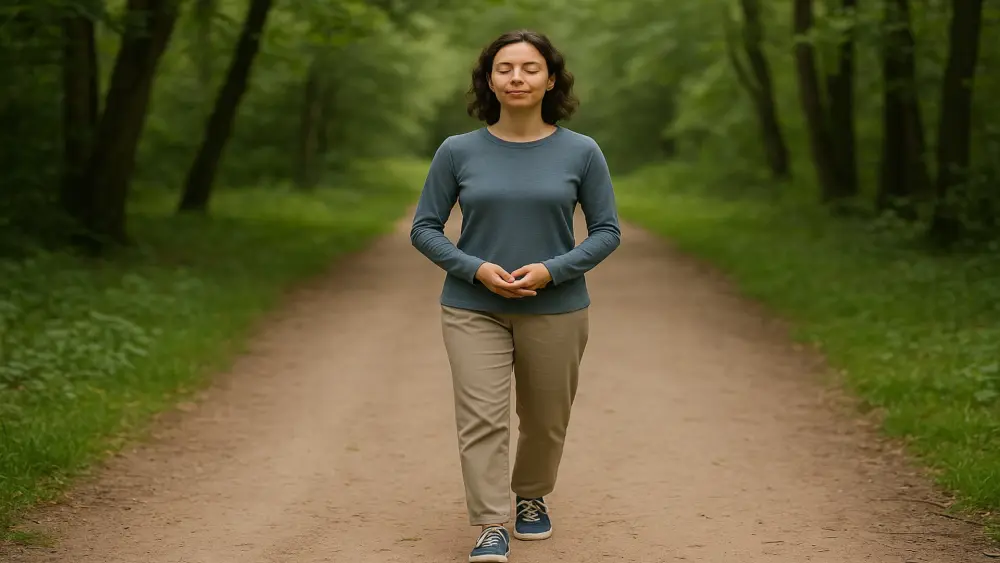
Relieve stress with meditation and breathing techniques
In addition to meditation, breathing exercises (source 5.) can also help reduce stress. The following techniques may work for you:
- 4-7-8 breathing: Inhale for four counts, hold for seven, and exhale for eight. This slows your breathing and calms the nervous system, which may reduce stress, depending on the person.
- Diaphragmatic breathing: Focus on breathing deeply into your diaphragm rather than shallow chest breathing. You can place a hand on your belly to feel the resistance as you inhale.
- Mindful breathing: A very simple technique. Sit quietly, close your eyes, and focus on your breathing. When your mind wanders, gently return focus to your breath.
- Box breathing: Also known as square breathing. Inhale, hold, exhale, and hold again—each for four counts. Visualize tracing the sides of a box as you breathe.
Sources
-
Selye, H. (n.d.). Quotes about stress. Goodreads. Link
-
Chrousos, G.P. (2019). Biological mediators of stress. In Stress and Disease (pp. 37–56). Springer. Link
-
Van Praag, H.M. (2004). Can stress cause depression? Progress in Neuro-Psychopharmacology and Biological Psychiatry, 28(5), 891–907. Link
-
Oman, D., Shapiro, S.L., Thoresen, C.E., Plante, T.G., & Flinders, T. (2008). Meditation lowers stress: Study among students. Journal of American College Health, 56(5), 569–578. Link
-
24High. (n.d.). Breathwork breathing exercises as a drug. Link
Disclaimer: The information in this article is for informational purposes only and does not replace professional medical advice. If you experience persistent stress, consult a doctor or qualified healthcare provider.