

Multiple Payment Options ✔️ Fast and discreet shipping ✔️ Customer Service Monday - Friday 10:00 - 16:00 ✔️ Free Goodies
Fast and discreet shipping!

WHAT IS TAROT? A GUIDE FOR BEGINNERS
More and more people are becoming interested in tarot. This is only natural, as tarot cards are utterly fascinating. The concept is centuries old, yet there are still many people who do not know exactly what tarot is at all and what it can be used for. In this article, we therefore explain what tarot cards are, how they work and what uses they have.
What exactly is tarot?
Tarot is a card game that has been used in Europe since the 15th century . Back then, the cards were mainly meant for games, but after a few centuries people started to see them more as a tool for self-insight and introspection . This is still the case today. Tarot is therefore used by most people to give an insight into their lives.
It is good to know that a tarot deck generally consists of 78 cards. They are divided into the Major Arcana and the Minor Arcana. The Major Arcana contains 22 cards that have powerful symbolism, the Fool, Magician and Lovers being good examples. The Minor Arcana has the other 56 cards divided into four colours or series, namely bars, cups, swords and pentacles.
How does a tarot reading work?
You now know what tarot is, but how exactly it works is, of course, also important to know. A tarot reading always involves formulating a theme or question. Next, cards are drawn and then placed in a certain pattern. This is called the laying pattern, of which the Celtic Cross is the best known. Here, ten cards are laid in a specific pattern to give a comprehensive picture. The next step is to interpret the tarot cards. Here, you look at what the cards mean and how they relate to your theme or question. In general, tarot interpretation is intuitive and symbolic, but can help people see new perspectives.
Tarot and self-insight
All in all, then, tarot is primarily a tool for self-reflection. You should definitely not think of it as a panacea with which to predict the future. Nevertheless, tarot cards can potentially scrutinise your thoughts and feelings. Tarot can also reveal connections and help you recognise patterns you may not have seen before. The deck is therefore used by most people as a kind of mirror, in which the symbols and images on the cards invite you to think more deeply about parts of your life.
Spiritual exercise
Yet for some people, tarot is more than just a tool for self-insight. Instead, they see the tarot cards as a spiritual exercise. Tarot is then used as a way to get in touch with your inner wisdom or spiritual guides. This doesn't necessarily have to do with religion; for most people, on the contrary, it is purely personal and spiritual. This makes it a ritual for some people to draw a card daily. They use this as a moment of reflection, so tarot can become a valuable part of your self-care.
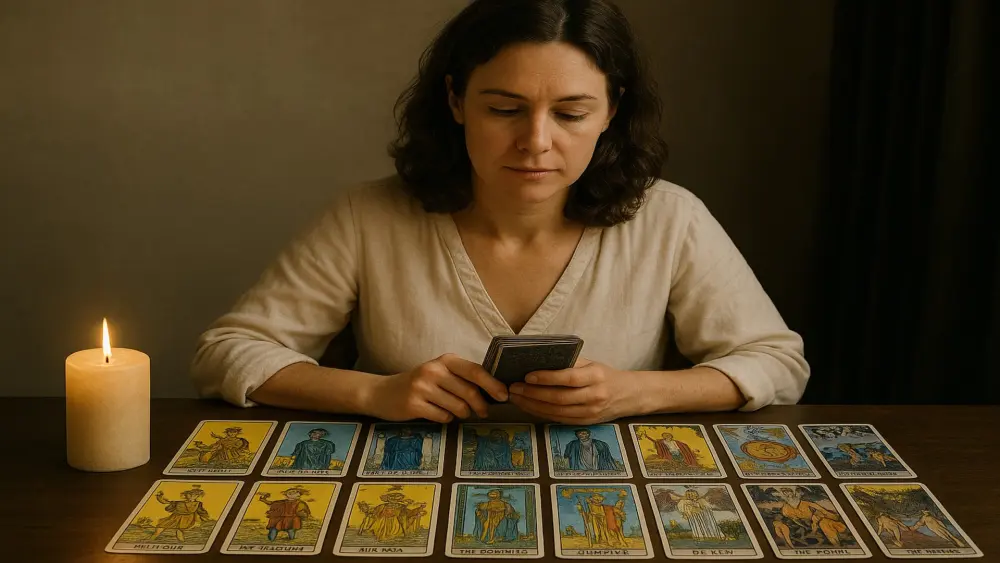
Tarot in the modern world
So tarot is already very old, yet this deck of cards is still used regularly. In fact, tarot cards are perhaps more popular than ever. As such, there are countless books, apps and online courses available for those who want to learn more about what tarot is and how to get started with it. There are also many tarot readers offering personal consultations, both physically and online. Still, you have to remain critical. After all, there is no scientific evidence that tarot cards or tarot really works.
What is tarot for you?
So now you know what tarot is; after all, it is an ancient card game that you can use to gain more insight into yourself and your situation. Tarot can therefore be a powerful tool for self-reflection and personal growth, although it doesn't have to be. It really depends on the person whether tarot is for you or not. You can always give the game a try and you might get new perspectives behind it, which will make tarot help you. However, it could also happen that you find it terrible and tarot is just not for you. That's not a bad thing at all, of course.
Sources on introspection and self-understanding
-
APA (American Psychological Association) - Self-Reflection and Insight Scale (SRIS):
Describes a validated scale to measure introspection and self-insight. Link: https://psycnet.apa.org/doi/10.1037/0022-3514.84.4.822 - Harvard Health Publishing - Benefits of self-reflection for mental health:
Highlights the importance of self-reflection for mental health. Link: https://www.health.harvard.edu/blog/the-power-of-self-reflection-2020021318816
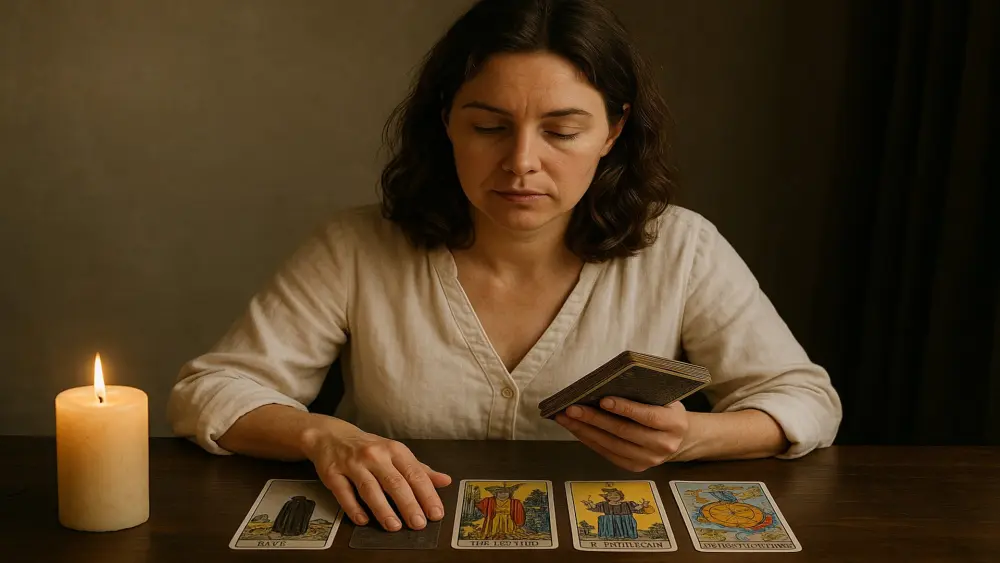
Scientific approach to spiritual practices (including tarot).
-
BMC Psychology - The psychological functions of spirituality:
Examines how spiritual practices such as tarot can function psychologically (e.g. as a c
oping mechanism). Link: https://bmcpsychology.biomedcentral.com/articles/10.1186/s40359-020-00413-2 -
Frontiers in Psychology - How spiritual tools contribute to mental wellbeing:
Tarot is not explicitly mentioned, but similar spiritual practices are discussed as sources of personal meaning-making.Link: https://www.frontiersin.org/articles/10.3389/fpsyg.2021.676400/full
Disclaimer: This article is intended for information and reflection. Tarot can be an inspirational tool, but it is not a substitute for medical, psychological, legal or financial advice. If you have any questions or concerns, always consult a professional.